
Tuesday, March 13, 2012

Saturday, February 18, 2012
SWTJ Exhibition Kyoto Prefectural Center for Partnerships with NPO
SWTJ exposition at the Kyoto Prefectural Center
for Partnerships with NPO (non-profit organizations)
SWTJ thanks the Kyoto Prefectural Center for the opportunity to report on SWTJ activities in the disaster area
Place: Kyoto Prefectural
Center for Partnerships with NPO, Nihonkan 1F
Time: March 1 to March 15,
8:30am-9:30pm
March 3 (Saturday): SWTJ Activity Report
and Charity Sale 10am-3pm
In
the exposition, SWTJ reports on its activities in the Tohoku disaster zone
since April 2011 through photos and texts. On March 3, SWTJ members will be
present and will be happy to answer your questions. There will also be a
charity sale of SWTJ-designed goods. The proceeds of the sale will be used for
the SWTJ March activity “Requiem in memory of the victims of the Great East
Japan Earthquake and Tsunami” in the disaster area.


場所:府庁NPOパートナーシップセンター(京都府庁旧本館1階)
3月1日(木)~3月15日(木)8:30~21:30 (4日休館日)
3月3日(土)展示説明会・チャリティーグッズ販売 10:00~15:00
http://blog.canpan.info/kyotoprefnpo/
Update Tsukidate Community Space!
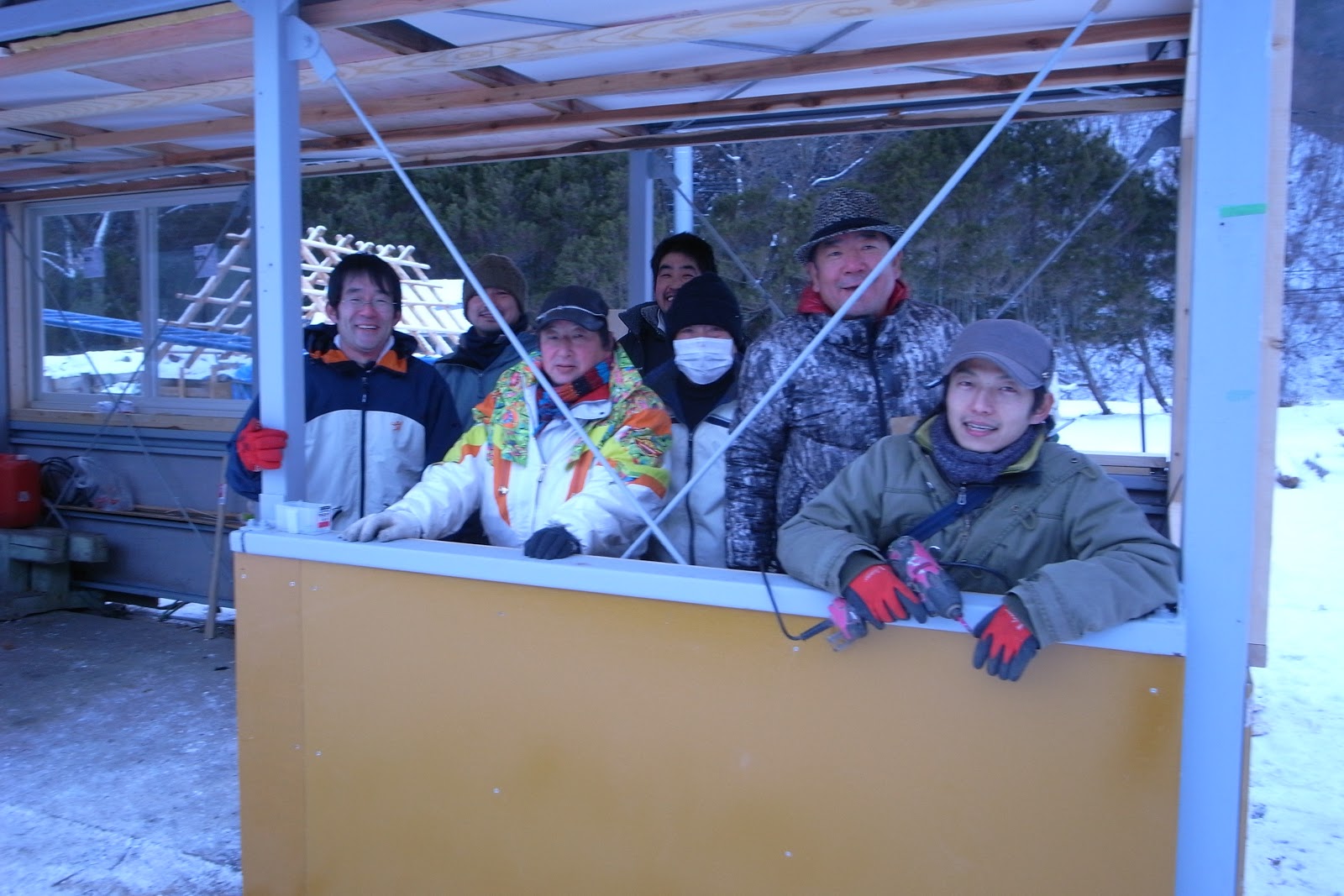
The SWTJ Tsukidate Community Space construction is advancing fast thanks to the hard work of the SWTJ carpenter team, including several evacuee residents of the nearby Tsukidate temporary housing who have been helping every day!


The space is a much needed place where the residents of this rural village in the hills of Kesennuma and the newcomer evacuee community can freely mingle and network. It will play an important role in integrating evacuees into the existing community.


There is still much to do! Our carpenters are still at work on-site.
支払いを待ってもらっています。


The space is a much needed place where the residents of this rural village in the hills of Kesennuma and the newcomer evacuee community can freely mingle and network. It will play an important role in integrating evacuees into the existing community.
BEFORE:
前

NOW:
今
NEXT:
これから
There is still much to do! Our carpenters are still at work on-site.
日本語:詳しくはこちら
HOW YOU CAN HELP:
List of goods still
needed
(Please contact us at contact@swtjp.org
if you wish to contribute any of the following goods, either in kind or as a
monetary donation. Any amount in a monetary donation exceeding the amount
listed will be used to fund SWTJ activities in Tohoku)
P.S. The 6 large windows mentioned below have already been inserted to make the
space usable as soon as possible. However, we still need a sponsor for them.
Aluminum-framed windows:
6 large windows (1900×1170mm) 357,000Yen (59,500Yenx6)
3 small windows (1235×1170mm)66,000Yen(22,000Yen×3)
1 aluminum-framed door (650×1846mm) 25,000Yen
2 ventilators (to be fixed on the wall) 17,800Yen (8,900Yen×2)
1 gas cooking stove (propane gas) 16,440Yen)
Solar panels to be fixed on roof surface of 28㎡(including cost to set up
electrical wiring) 1200,000Yen
1 home movie system
116,000Yen
Speakers: 39,285Yen
(DVD player: 37,900Yen: the DVD player has been donated. Thank
you!)
Read more on the project in English here:
日本語
▶【ご支援、ご協力のお願い】
心地よい環境に作り上げるには様々なモノが必要だと考えています。そのモノを提供して頂ける方、もしくはそれを購入するための資金を募っています。(必要額を超えた資金は通常の活動支援金として大切に利用させていただきます)
詳しくはこちら
<支援対象品>
アルミサッシ大 (1900×1170mm)×6枚 357,000円
アルミサッシ小 (1235×1170mm)×3枚 66,000円
サッシは、まだスポンサーが見つかっていませんが、寒いので設置しました。支払いを待ってもらっています。
アルミドア 650X1846 1枚 25,000円相当
壁付け換気扇 2台 17,800円相当(8,900×2)
ガス台(2口、プロパン) 1台 16,440円相当
ソーラーシステム 一式 28㎡屋根部分施行、電気設備工事費 1200,000円相当
メーカー:京セラ
サイズ:990mm×1340mm
出力:1枚当たり186w
設置数:14枚 2.604KW(最大で100wの電球 23~26個程度)
ホームシアター 一式 液晶ビジョン52型 116,000円相当
スピーカーシステム 39,285円相当
DVDプレーヤー(カラオケ対応)37,900円相当
(↑提供者が決まりました。ありがとうございます!)
Monday, February 13, 2012
SWTJ 11th Tohoku Activity Week February 2012
SWTJ carpenters hard at work!
Tsukidate Post-Disaster Community Space in the hills of Kesennuma
This is the very coldest season of the year!

Tsukidate community space under construction next to Tsukidate temporary housing
Yes, temperatures are below zero! But the SWTJ carpenter team cannot waste any time. The evacuee community in the neighboring temporary housing is quite isolated, and has currently no space where they can freely gather, and where they can mingle with locals, volunteers, and other visitors. The bus to downtown Kesennuma runs very infrequently. It is cold, and lonely. Some of the evacuees who now have neither a car nor a job tend to stay in their rooms at all time.

At work: SWTJ Representative Yoshikawa (left) and SWTJ Kesennuma Branch Head Tamura

Adding the windows

Saturday Feb. 11: Windows fixed!
Charcoal Kiln:
Behind the Tsukidate community site under construction, Mr. Tamura is currently fixing the roof of a new charcoal kiln, a project of the local Yasse Forest Education School 'Yasse Mori no Gakko.' Charcoal has been produced in Yasse for centuries. Mr. Tamura, who is also the SWTJ local representative in Kesennuma, is a local charcoal maker and expert, an educator on regional natural resources, and an ecotourism leader. The charcoal will be put to good use in the new Tsukidate community space.

Mr. Tamura on the roof of the charcoal kiln

Mr. S. and Mr. Y. from the temporary housing site help the SWTJ construction team. Thanks! ((February 13th)
SWTJ's Yasuo Yoshikawa says: "I'm so glad that people from the temporary housing actually come out of their rooms to help us build the space. After work, we often share a meal. Many locals also come by regularly to see how work advances. Everybody is looking forward to the completion of the space!"
Text by Beatrix Yoshikawa, SWTJ
SWTJ still needs funds and donations in kind for the Tsukidate community space. If you are interested in taking part, find more information on what is needed here:
Tomorrow, February 14th, is the start of the SWTJ Valentine Activity Week! Look out for our blogs on Valentine chocolate-making workshops in child centers and temporary housing complexes in the disaster area during the next few days.
Tuesday, January 31, 2012
SWTJ 10th Tohoku Activity Week January 2012
Report by SWTJ volunteer Akane Fujimoto

SWTJ staff member Watanabe is behind the tempura frying counter. Having taken part a month ago in a similar event, his cooperation with the local ladies is perfect. Especially the shingiku chrysanthemum leaf tempura is delicious!

SWTJ Kesennuma Branch members Tamura (front) and Yoshida (back) are hard at work preparing soba noodles from scratch. Both are highly concentrated on their work- no unnecessary words are exchanged during this crucial process.

A vending car came by the Tsukidate site: local ladies sold tai-yaki, a pancake-like sweet filled with bean jam. The ladies were very generous and gave us plenty! This is an example of local small business picking up.

This picture shows a veteran lady from the Mori no Gakko Nature School and myself. I hope I was of some help, although it was my first time! Looking already forward to being here again!
Shinnenkai in Rikuzen-Takata

At the shinnenkai, I also met a woman from Kumamoto, Kyushu, who is a nurse like myself. She had been sent to this area as medical staff in May last year right after the disaster, and although she is now back home, she still has close ties with the evacuees who had received her care in large evacuation centers or schools last year. Like her, many people from other areas who have been in contact with evacuees once keep coming back to nurse their friendships and bonds with the evacuees.
In many areas of the disaster zone, three-generation households were common. However, many families have been torn apart by the disaster. Due to various reasons such as vicinity of schools or age, they now have to live in separate temporary housing sites, far from each other.
Although I have been active as a SWTJ member for more than half a year doing back-stage support including helping out at the sake-matsuri SWTJ fundraiser in Hiroshima last October, this is the first time I accompanied SWTJ in the disaster area. I took part in the January SWTJ Activity week from Jan 21 to Jan 23. Even though my stay was short, there is so much to report.
Taking part in the Mori no Gakko Nature School Soba Buckwheat Noodle Event
When we arrived at the Old Tsukidate Elementary School, we were warmly welcomed by the SWTJ Kesennuma local staff. After tea-time and unpacking, we were briefed on the Noodle Community Lunch Event with locals and residents of the neighboring Tsukidate temporary housing site that would be organized the next day, and in which we would help during the morning. After that, we would head to Rikuzen-Takada in the afternoon for a community event with evacuees in temporary housing there.

SWTJ staff member Watanabe is behind the tempura frying counter. Having taken part a month ago in a similar event, his cooperation with the local ladies is perfect. Especially the shingiku chrysanthemum leaf tempura is delicious!

SWTJ Kesennuma Branch members Tamura (front) and Yoshida (back) are hard at work preparing soba noodles from scratch. Both are highly concentrated on their work- no unnecessary words are exchanged during this crucial process.

A vending car came by the Tsukidate site: local ladies sold tai-yaki, a pancake-like sweet filled with bean jam. The ladies were very generous and gave us plenty! This is an example of local small business picking up.

This picture shows a veteran lady from the Mori no Gakko Nature School and myself. I hope I was of some help, although it was my first time! Looking already forward to being here again!
Shinnenkai in Rikuzen-Takata
SWTJ joined hands with the staff of the Zaitsu Temporary Housing Site in Otomo, Rikuzen-Takata,
in organizing the first community event (shinnenkai) of the year.
For this event, SWTJ prepared kasujiru-soup, a traditional vegetable and fish soup based on miso and sake lees. This is actually the dish that SWTJ prepared in its soup kitchens back at the time when we were up in the disaster area last April! Kasujiru wonderfully warms the body.
This time, 20kg of sake lees for the soup, and additionally delicious sake rice wine, were donated for this shinnenkai by the Higashi Hiroshima Sake Brewery Kamotsuru. We thank this generous donor for their big donation! We prepared the soup on-site with the efficient collaboration of the residents of the temporary housing.
One of the evacuees in the temporary housing told me that he had been a fan of Kamotsuru rice wine since before the disaster, and that he had actually preserved a nice label of a bottle from 18 years ago, but that of course the tsunami had swept it away...but that he was glad to be able to encounter that sake again at the shinnenkai! 'Yes, this one, it was this one!', he exclaimed delightedly.
This same resident had been in the mountains hunting game a few days earlier, and brought carefully cut deer fillet steaks to the dinner. There are not many people who both hunt and also know how to prepare the deer, but he was one of them. Some of the best cuts were served raw as deer-sashimi, together with wasabi Japanese horseradish. Truly delicious. Some other evacuees at the temporary housing brought delicious homemade giant radish pickles and other treats to the event.

←This is 'hatsu' or deer heart from one whole deer
・・・the hunter told me about the different cuts of deer and how they needed to be prepared. All truly delicious.
At the shinnenkai, I also met a woman from Kumamoto, Kyushu, who is a nurse like myself. She had been sent to this area as medical staff in May last year right after the disaster, and although she is now back home, she still has close ties with the evacuees who had received her care in large evacuation centers or schools last year. Like her, many people from other areas who have been in contact with evacuees once keep coming back to nurse their friendships and bonds with the evacuees.
In the disaster area for the first time:
For the first time, I visited Kesennuma, Rikuzen-Takata, and Minami-Sanriku with SWTJ. Standing on the ground and thinking that the tsunami wave was many times my own height when it destroyed everything is still hard to imagine. People used to live here. We may not forget their fate.
 |
| Sea water at Kesennuma's coast still stands in the area |
 |
| Rikuzen-Takata has been mostly cleaned from rubbish. There used to be a town here. |
 |
| Minami-Sanriku, Shizugawa |
The things that one cannot see
During my short time in the disaster area, the following realities struck me:
In many areas of the disaster zone, three-generation households were common. However, many families have been torn apart by the disaster. Due to various reasons such as vicinity of schools or age, they now have to live in separate temporary housing sites, far from each other.
People from widely different towns and villages now live in the same temporary housing site, often finding it hard to make new friendships.
Measures to protect temporary housing units from the cold vary from town to town. There is no common strategy, and some were protected against the cold early, some later, some worse, some better.
A large number of people need home care or medical care. It will be essential to strongly support care personnel.
There are still many people who find it hard to share or express their worries and hardship.
It will be essential to keep in contact with the same group of evacuees over a long time in order to efficiently help.
 |
| SWTJ member Watanabe listens to the leader of a temporary housing complex in Rikuzen-Takata |
The amazing energy of the local people
Preparing for future activity weeks
My stay in Tohoku was only brief, but the locals greeted me with wonderful warmth and called me 'mago' or 'musume,' (granddaughter, daughter), as if I were family. I was deeply moved by their kindness, and by how, in spite of, or perhaps rather as a result of, all the hardship and pain that cannot be understood by any outsider, they so cordially welcomed a newcomer like me. And I felt an amazing energy and underlying strength in the people we met. I want to thank them so much for all that is beyond anything I can express here.
During each SWTJ activity week, we must also think ahead and meet the key people for our future activities which we always plan in close cooperation with local leaders. This time, we drove to Utatsu in Minami-Sanriku to discuss cooperative events during our March Activity Week which will be spent in memory of the victims of the March 2011 disaster, and during which music will be at the center of our activities, as it can better express than words what will be felt by so many during the days that brought incredibly tragic events to so many people last year.
The people in Utatsu remembered SWTJ well from previous visits and were very glad to hear that we would organize events together soon.
 |
| Last December, Utatsu Village in Minami-Sanriku finally reopened a line of former shops inside provisional buildings in the middle of a vast plain of destroyed land. The words on the paper boot read 'We will never cease to rescue one another.' |
SWTJ Kesennuma Branch Project: 'Tsukidate Salon'
And here finally a photo of the Tsukidate community space, an ongoing SWTJ project that will provide a much needed gathering place for temporary housing residents, locals, and volunteers in the region! While I had to return home to Hiroshima, SWTJ members Yoshikawa, Watanabe, and Koike worked hard in the biting cold to rebuild the place which will turn into a multi-purpose community building soon. The locals already call it the TSUKIDATE SALON! More on the carpentry work in future reports.
 |
| The future 'Tsukidate Salon' |
 |
| Old Tsukidate Elementary School winter landscape |
Our stay fell into the coldest season, and the area around the Old Tsukidate Elementary School was a winter wonderland, a place where one wants to come back to.
Even if you cannot stay for long, if you haven't come yet, you will want to visit the beautiful natural scenery of Tohoku which extends over so many regions.
There are many different and valuable ways of providing support to disaster victims. But after this stay with SWTJ in the disaster area, I became convinced that the perspective of SWTJ-- building close relationships with people in the disaster area, creating spaces where people can meet, and cooperating in community-building events-- is necessary not only now, but will be needed over a long period.
 s s |
| The Goro statue at the Iwai coast in southern Kesennuma, with SWTJ representative Yoshikawa. As the locals say: 'Mina de gambappe na!' (Together, we will overcome!) |
Text and photos:
Akane Fujimoto (licensed nurse), SWTJ Hiroshima Branch
(Translated and edited for the English version by B.Y.)
Subscribe to:
Posts (Atom)