Friday, September 23, 2011

SWTJ's Kyoto Caravan in Tohoku for the 6th time


From September 10 to September 19, SWTJ traveled to Tohoku for the 6th time since April with six members of the Kyoto Caravan to provide food and events, to connect, and to gather information for SWTJ's future activities. In Tohoku, the Kyoto members were joined by SWTJ Kesennuma branch head Yoshida and by SWTJ Tokyo branch head Tago. 
  
This picture shows members of SWTJ in front of kasetsu jutaku  (temporary housing for evacuees) on the Hirota Peninsula in Rikuzentakata.

Six months after the earthquake and tsunami of March 11, many evacuation shelters have closed, and a large number of evacuees have now moved into temporary makeshift homes that have hurriedly been built by the government in a large number of locations- some in the vicinity of former neighborhoods that are now destroyed, and others in the hills overlooking the coast. People must now get used to their unfamiliar new environment. Once they move away from shelters, they lose the access to the free food, water and amenities they had in the shelters. Many of the evacuees who have lost their homes, jobs, and family have no income, and find it extremely difficult to start life in temporary housing where they have to start paying for their own life.  
This time, SWTJ not only prepared its usual food, but was entrusted to bring some special goods donated by Kyoto companies to the people in Tohoku. The Japanese sweets from the Ohara Meya sweet shop in Kyoto Gion, and the candies from the Gosho Ame Japanese candy shop in Kyoto Sanjo Kiyamachi were loved by all!


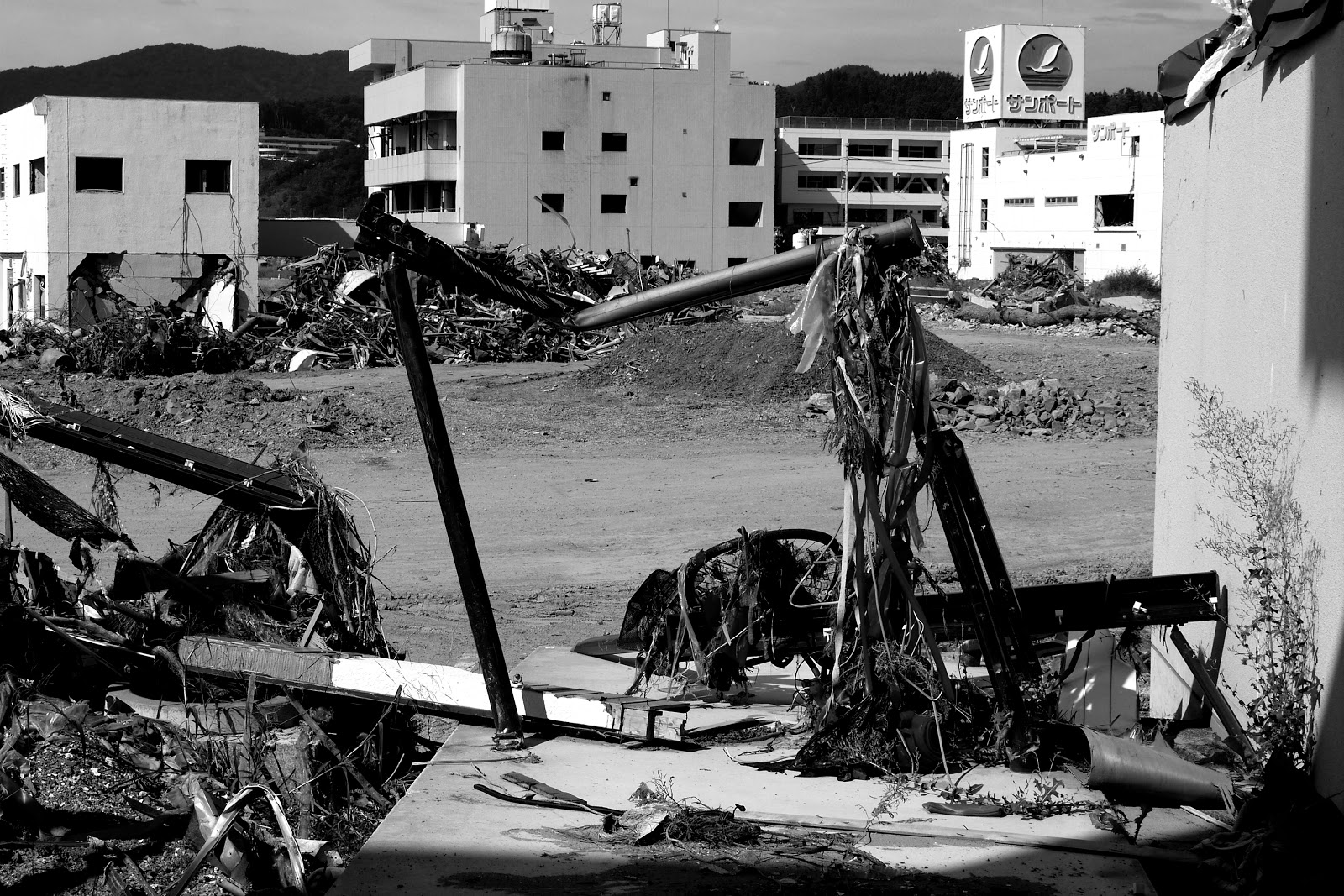
This picture features an area in Kesennuma Minamimachi, on September 17. Minamimachi has been hard hit, and the area is deserted and quiet. While most debris have been cleaned away, damaged homes and businesses have remained as they were right after the disaster. While they seem too damaged to be inhabited again, they are precious assets to their owners. Not only the houses are damaged- the soil has been liquified as a result of the earthquake. Investigations on whether it is safe to rebuild stagger, and the slow decision-process on how and whether cities will be rebuilt, and whether insurance will be paid, hinders progress in the decision process regarding reconstruction.
A rare symbol of hope in the middle of Minamimachi: here, residents have planted a green lawn above which they have hung fishermen's flags featuring the characters for a large catch of fish.

While in the area, we sighted many volunteers who had come to Tohoku with tours arranged by travel agencies, mostly from the Kanto area. Such tours offer so-called volunteer tourism. They arrange for volunteers to clean out houses and street gutters in damaged areas. For people who wish to volunteer and who find it hard to get information on how to help, these tours (for which they pay) are an easy way to get involved.


From Minamimachi towards the old fish market. Here, debris still line the road. In the back, a destroyed hospital. 


Damaged homes in in daily flooded areas.

Destroyed cars still line the roads. The characters 'kanryo' (completed) or the letters 'OK' drawn on a car indicate the fact that the vehicle has been checked for missing people.


In comparison to the last time we came, the stench near the ocean had diminished, and there were fewer flies. 


Text and Photos: SWTJ   Head of Office, Yamanaka Jumpei

Highway 45: from Kesennuma to Minamisanriku (September 2011)
(Photos: Copyright SWTJ. The use or alteration of these pictures is strictly forbidden)


The Kesennuma Hajikami Cemetery on the southern coast of Kesennuma was badly damaged by the March 11 tsunami. The cemetery contains many monuments in memory of the people who died in the Meiji Sanriku Great Tsunami (1896) and in the Showa Sanriku Tsunami (1933). Inscriptions on the monumental stones remind people to flee to high ground in the case of an earthquake.    
The Hajikami Sea Route, southern coast of Kesennuma
The remains of Kesennuma Koyo High School on the southern coast of Kesennuma
Rikuzen-Koizumi

Kiyomizu Beach


Vicinity of Matsubara Park in Shizugawa-cho, Minamisanriku

Vicinity of Matsubara Park in Shizugawa-cho, Minamisanriku

Vicinity of Matsubara Park in Shizugawa-cho, Minamisanriku

Vicinity of Matsubara Park in Shizugawa-cho, Minamisanriku


Vicinity of Matsubara Park in Shizugawa-cho, Minamisanriku


Vicinity of Matsubara Park in Shizugawa-cho, Minamisanriku


Vicinity of Matsubara Park in Shizugawa-cho, Minamisanriku

Text and Photos: SWTJ   Head of Office, Yamanaka Jumpei
(Text edited for the English version by B.Y.)


SWTJ visited the local government's volunteer center. Its official name is Kesennuma-shi shakai fukushi kyogikai volunteer center 気仙沼市社会福祉協議会ボランティアセンター

Like many other cities in the disaster area, Kesennuma set up this volunteer center, located along the highway next to the home for the elderly 'Sukoyaka,' right after the earthquake and tsunami. The center has welcomed large numbers of volunteers from the whole country since its establishment. Volunteers help clean out mud from homes, clean away debris, and sort and save damaged photos, among other jobs. Until 'Golden Week' in May, 300 volunteers gathered at the center every morning from 8 am. From August, the number of volunteers began to shrink. The center now has only few volunteers.

However, unlike in Rikuzentakata or Minamisanriku, where debris have largely been cleaned away, in Kesennuma, there is still a lot of work to do, and there is still a dire need for volunteers. But the city finds it hard to continue to coordinate volunteers and to organize their work through the center. There is a lack of staff and money. The center now limits the number of volunteers it accepts at one time to 50 people. Volunteers can not just show up, they must apply at least 4 days ahead.  On the day we visited, volunteers were sent to Oshima Island and to Minamimachi in Kesennuma to shovel mud and clean houses.


The volunteer center provides volunteers with tools and even clothing, and steel soles to put into shoes for protection. It is thus possible to arrive without one's own tools. Volunteers are then given a band to put around their boots which indicates the job they are supposed to do. Tools and clothing are neatly arranged under a tent.
Wheelbarrows, crowbars, and other tools are waiting for volunteers.


After a general orientation, the 50 volunteers are divided into groups and given specific instructions.


Each group gets a safety kit.

A small bus takes the volunteers to the site of their work. Wheelbarrows and other tools are taken along. Some volunteers drive their own cars or bikes. 
On Wednesdays, the volunteer center is closed. There are some volunteers who arrive without knowing this, and who find themselves out of work after having come a long way.


SWTJ Head of Office
Yamanaka Jumpei

Saturday, August 13, 2011

SWTJ Photo Exhibition in Kyoto from August 23-28, 2011


5 months after the earthquake and tsunami in northeastern Japan, 

many evacuees still live in evacuation centers or crammed

temporary housing. SWTJ has been organizing soup kitchens and 

events for kids in the disaster area since April. Come and see SWTJ' 

work in pictures, meet SWTJ members, and enjoy one of the 

traditional snacks we prepare together with kids in evacuation 

centers, schools, day care centers, and temporary housing-villages 

in Tohoku.


Photo: Kanazawa Daisuke


23 (Tue)-28(Sun) August

Open: 


23-26 August: 5pm-8pm


*27 August (Sat): 12pm-8pm


28 August (Sun): 12pm-6pm

*On August 27 (Sat), SWTJ will report on its activities from 


6pm, followed by a party during which you can try the snacks 


SWTJ makes for kids in Tohoku, including takoyaki 


dumplings and cotton-candy. These will be on sale together with 


home-made sangria and a series of SWTJ 


Solidarity Goods. All profits will be used for support activities 


by SWTJ in the disaster area. 


Place: Yamamoto Gallery, on Anekoji-dori (a small street 


linking Kawaramachi-dori to Teramachi-dori), 4 minutes walk 


from Kyoto Shiyakusho-mae on the Tozai Subway. See map 


below:

 <http://gallery.framing-y.com/ >


Sunday, August 7, 2011

KESENNUMA four and a half months after the disaster

On August 1, 2011, four and a half months after the March 11 earthquake, the port town of Kesennuma in northeastern Japan counts 1'000 dead residents,  and 417 missing.
The town still runs 36 evacuation centers, where people who survived the earthquake, tsunami, and fire continue to live in humid and hot community halls, schools, or gyms without any privacy.

The city has been building 3'400 units of temporary housing (including those still under construction)- small barracks into which people can move once they have drawn the right ticket in the lottery for these units. The application deadline for the barracks was July 12.  Considering that about 13'000 homes in the town of Kesennuma were either washed away, destroyed, or partly destroyed, the number of temporary housing units is far from sufficient for all evacuees. 

From July 10, the supply of food and other necessities for daily life to people who do not live in evacuation centers was stopped. Some needy people had no other choice than to move back into one of the evacuation centers in order to receive food.  

Towns and villages over several hundred kilometers along the Sanriku Coast on the Pacific Ocean in northeastern Japan have been swallowed by the tsunami.  The battered coast now looks the same over endless distances.

Kesennuma suffered the triple disaster of earthquake, tsunami, and fire. Two huge fires broke out in which many people perished. Many homes and factories were burnt to ash.  

The hoyaboya character: a symbol of recovery

Everybody in Kesennuma knows him. He is a symbol of this fishery town's strong will to recover and thrive again. With a saury as a sword, a scallop as a belt, and a cap that resembles a hoya or sea squirt, he courageously rides on a shark. 


<ホヤ・ボーヤ>

Visiting Tohoku as a tourist:

Many people who travel to Kesennuma work as volunteers: They cook in evacuation centers, clean mud from homes, or organize events for children. Thanks to the kindness of the local people, SWTJ volunteers can stay in an abandoned school in the hills of Kesennuma during their support trips in the area. Other volunteers who travel to Tohoku stay in so-called volunteer villages where they can camp. 


Members of SWTJ on their way to Tohoku


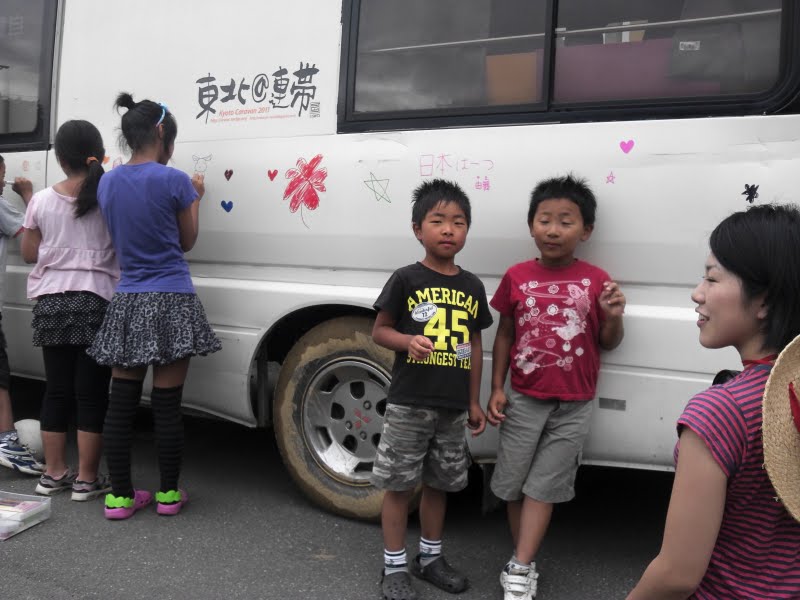
Children in Tohoku help paint and decorate the SWTJ transportation bus


However, slowly the hotel and pension business in the area has started to come back. So there is yet another possibility to help the area: if cooking for hundreds or cleaning out mud of houses is not your thing, you can still support the ailing local economy by using its services.

Anyone who hopes for a quick recovery of the disaster area can personally help by coming as a tourist to the region and using money here. A steady flow of people and money is essential for the region to recover. It may sound sarcastic to encourage people to be tourists in the disaster area, but it is important that people come and look at the mountains of debris that still cover the disaster area-- simply because it is just not possible to imagine the extension of the damage without actually seeing it. People, homes, shops, and factories were simply washed away. Those remaining have lost whole neighborhoods, all infrastructure, and every lifeline. Without seeing the damage, we easily forget about the fate of the survivors.

I encourage everybody to come and stay, to travel, eat, drink and buy in Tohoku. Recovery here is slow, but little by little hotels, pensions, restaurants, shops, and boutiques are reopening. Let's support them by using them!

Here is some information on hotels or businesses in Kesennuma that have reopened:

Kesennuma Tourism Association:


Text: Yamanaka Junpei (Head of SWTJ Kyoto Office)

(Edited for the English version by B.Y.)

Friday, August 5, 2011

Food and recreation for kids in the disaster zone

July 28: SWTJ at Shinjo Elementary School

In the morning of July 28, a group of four SWTJ volunteers who worked with us on the ground for the first time were taken to the coast areas so that they could see where the evacuees are originally from. It is important for volunteers who enter the disaster area for the first time to be briefed on the disaster and on the current state of the areas from which the people we work with were evacuated.


Nearly five months after the disaster, wide stretches of land still look the same: boat washed into residential area (July 28, 2011)


Cleanup of debris will take a very long time (July 28, 2011)


In the early afternoon, we drove to the nearby Shinjo elementary school where the kids were already waiting for some rare treats and recreation

SWTJ on the way to Shinjo elementary school (July 28)

Unpacking of SWTJ gear in preparation of an afternoon of cooking and recreation for kids at Shinjo elementary school in Kesennuma, Miyagi prefecture. Today, our photographer Kanazawa Daisuke helps out in the kitchen!

SWTJ Yamanaka Junpei sets up the cotton candy machine
Soon, a lot of kids stood in line for the treat. 
Back left: SWTJ Head of Office Yamanaka Junpei
Back right: SWTJ Head of Kesennuma Branch Tamura Taiji.

Okonomiyaki pancakes made with and for the kids
After the food, the recreation! Kids gather around SWTJ soccer coach Kanazawa Ryo. Soon the soccer teams are ready to go.


Many kids commute to elementary school from evacuation centers or from tiny crammed temporary barracks. Recreation activities during the day are crucial for their well-being.

Ogawa Hayato, SWTJ member on the ground with SWTJ for the first time, says: 'It was tough to see the reality in the disaster zone this morning. I felt helpless in front of so much destruction. But working with the kids at the school this afternoon has given me a lot of motivation. We really can learn so much from the people here. I came with the intention to encourage the evacuees. But instead, they seem to have encouraged me. Heartfelt thanks to all the kind people at the Shinjo school!'

Photos: Ogawa Hayato
Photo text: Ogawa Hayato
(Edited for the English version by B.Y.)